Tuesday, April 23, 2013

Morning train to Hsipaw

The alarm of my smartphone woke me up at 2.00 am, and I swiftly packed and braced myself for checkout. We settled the bills, and marched out into the chilly quiet streets with our backpacks on our shoulders. 

It may sound weird, but I loved how the streets were at early wee hours; it was barren, cool and quiet. What a total opposite of day time! Although there were poor street lighting, and we were virtually alone, except for occasional "Hi, you want motor taxi" yells from passing by motorbikes. To be honest, I was least worried that we would be mugged here, and this bizarre sense of tranquility felt so comfortable to me.


After a 20 minutes stroll we eventually arrived at the railway station, which looked more like a hotel to me from the outside. Along the way, there were the homeless sleeping on the streets with merely a dirty unsightly blanket, and that was really sad; we could see children hugging each other for warmth in between their parents on a used unwanted sofa on sidewalks, with stray dogs wandering around entertaining themselves with their own game of tag. 

Inside the railway station however there were already a small crowd waiting to board the 3am train to Hsipaw. Somehow, everyone was very courteous to foreign tourists, and we had no difficulties locating our train nor our seat. USD9 for an upper class seat - a semi-functioning reclining chair, with ample leg space too! - is already comfortable enough for me. 


As the whistle blowed, the train slowly rattled and started crawling along the tracks towards the northeast. I dozed off almost immediately when the train exited the stony concrete jungle of Mandalay into the rural area, and as we woke up, we were already approaching Pyin Oo Lwin or Moulmein around 9 am, which is a hilly escapade for locals, but a more rundown version of Malaysia's Cameron Highlands.


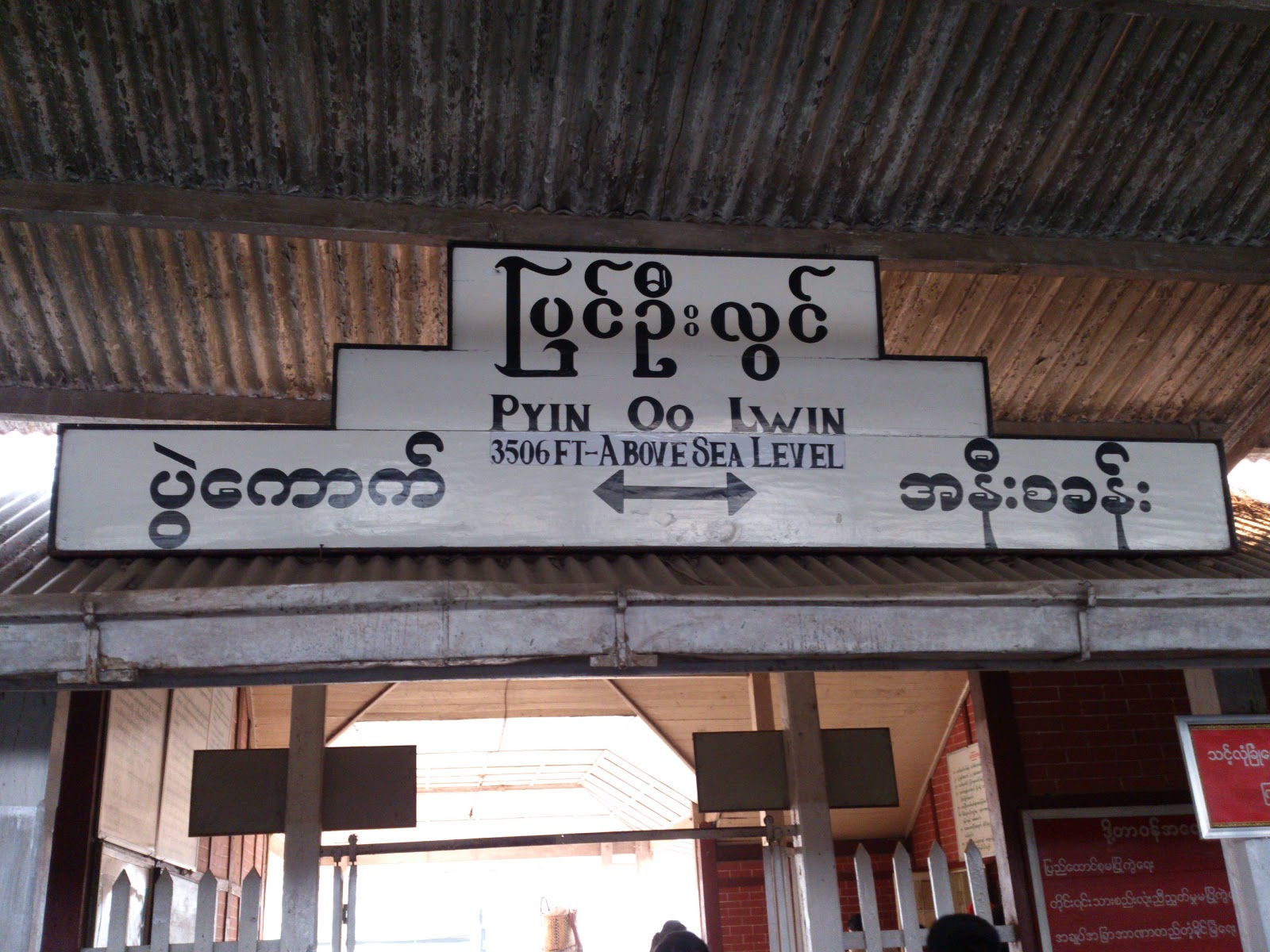

The train only had a 30 minutes halt in each major stops; so there was sufficient time for peddlars to hope on trains to sell their wares, or for passengers to leap off the train to stretch their legs and buy something to fill their effervescent hunger. I bought some fried noodles and deep-fried bird that looks like chicken, while my buddy bought some strawberries. We expected it to be sour, but to our surprise it was not too bad! We came at the right season where Pyin Oo Lwin is packed full with strawberry harvests! 


Train services in Myanmar are very slow, and inefficient; it is almost twice the normal travelling hours via a bus, but cheaper. Only at 11.00 am did we arrived at our most anticipated sight of wonder - the Goktheik Viaduct. This architecture wonder (well, it was considered to be amazing in 1900) spanning almost a kilometres across a deep valley, has been described by Paul Theroux in his "Great Railway Bazaar" as "a monster of silver geometry in all the ragged rock and jungle, its presence was bizarre". The train gently danced it way across the viaduct, as we gasped with vertigo while we looked down and frantically take photos of every angle we could. It took us around 20 minutes to span the entire viaduct, and soon we were on our way to Hsipaw.


Hsipaw is a small little town located to the northeast of Mandalay, in the heard of the Shan region. So far, this laid-back town has been gradually prospering from the increasing tourists visits, but still the people here are very much friendly and we still enjoy the "Hello" and "How are you" from the locals. We arrived here around 4 pm, and stealthily sneaked past the touts who ambushed the other foreigners like vultures.

I almost fell in love instantly with this cowboy town! It's such a laid back town with no hustle or bustle or crazy wild traffic like Yangon or Mandalay! Our hostel was within walking distance, and upon arrival we were amazed; it was one of the best places we had  stayed in Myanmar! Lily's Place is just simply gorgeous! It is clean, and near to downtown and Lily (the owner) by far is the most hospitable and helpful innkeeper we have met in Hsipaw! She made us feel so in home and helped us almost very sincerely (well, it felt that way) and we really liked this place.

As we arrived, we checked in, dumped our bags and headed towards the sunset hill which is like 1 km away from downtown. Having panted with exhaustion hiking up the hill, I was rewarded by a splended view from the temple above the hill. We could see the sun setting beyond the horizon with our little jewel town, Hsipaw, under our feet. We were joined by a local monk and 2 visitors, as we chit-chatted and waited for the sun to sink into the mountains. However, from afar we could see the thickening haze from the forest fires afar. Pollution indeed has crept its way to everywhere we go it seemed. 


When nightfall has already encloaked the town, we were already on our way back to our hotel, looking for a place to ease our hunger. We stopped at a local restaurant, run by a local "Mr Food", but the services were inferior to its reputation. After dinner, I had a glass of strawberry lassi at "Mr Shake's" place and it was just splendid.

And when we finally arrived in the hotel, we met the elderly Singaporean couple whom turned out to be a nightmare for me, the second day!

Friday, April 19, 2013

Day trip to Mingun and a short walk in Mandalay

We took a day trip to the nearby village of Mingun, which is located 1 hour via ferry ride, to the northeast of Mandalay. We walked around 2 kilometres from our hotel to the Mayan Chan jetty where we waited for 30minutes for our ferry and the ticket costed us 5000 kyats. There were already a few tourists queuing up for the once a day ferry, which I heard would not take us if there were less than 5 tourists then. At 9 am sharp, we boarded the ferry and started the journey.


The ferry sailed upstream of the Ayerwaddy River, passing by fishing boats and transports loaded with all sorts of cargo. I am quite amused to see the other foreign tourists being so intrigued by people living on or beside the river; they get so exhilarated seeing the local people bathing or doing laundry by the river! For me, I tried to catch some forty winks while enjoying the river breeze. 


After an hour, we eventually reached Mingun, and we were welcomed by the unfinished Mingun Paya. While we were busy gazing at the temple, wondering whether to go in and visit, we were ambushed by two government officers asking us to buy the admission ticket. Actually, any foreign tourist who visits Mingun is required to purchase the USD3 admission ticket, unless you are fortunate enough to get away with it. We were rather unfortunate, even though we acted dumb and just walked away, ending up with the officer trailing us for around 10 minutes. We gave in eventually; it's just our luck!

Since we paid for the admission ticket, we might just as well have the most of it. The Mingun paya, although unfinished, still looked humongous! If completed, it would have been the largest stupa in the world! Hence, it is now the largest pile of bricks in the world! We were not allowed to climb up to the top anymore as they put up a sign forbidding us to do so since the structure was not stable anymore, hence we just walked around it and take a few snap shots, barefooted under the hot sun.


Next to it is a temple housing the world's largest uncracked bell, the Mingun bell weighing 55,555 viss (90 tonnes). I managed to scramble beneath and stand within the 13 foot tall bell! The Hsinbyume Paya, further down the road has seven terraces, all laid up with small Buddha figures, while there's another Settawya Paya which has a footprint rumoured to be of Buddha's himself. 

Otherwise there isn't anything much else here, except hoards of tourist-preying pedlars and souvenir shops. We grabbed a quick lunch, and went back to the ferry to wait for departure at 1 pm. 

We encountered a Singaporean elderly couple whom we befriended (possibly a disaster, will tell in future posts) earlier in Bagan. Since they were also heading for Hsipaw too the following day, we booked the hotel they recommended to us. After arriving back in Mandalay, we took a songthaew for 500 kyats per person (cheap!) and headed back near our hotel, where we took a short stroll to the railway station to get us tickets for Hsipaw.

Well, we were advocated to avoid government-affliated facilities as much as possible, but the only way to experience the Gotheik Viaduct is by train, and that left us with not much choice. Hence, we bought 2 upper class seats for USD9 each at the station and headed back for our hotel to rest, after stopping at a local supermarket for some groceries.

I woke up from my nap in late evening, ad we went to try the local Shan dishes, near our hotel. It costed me 3500kyats for a eat-as-much-as-you-can buffet, but I never really liked Burmese cuisine so I felt content with just 2 rounds of servings.

Well, that's probably what we really had in Mandalay, and we skipped Inwa and Sagaing because we were already tired with temples and stupas. Maybe we just need something new.

Mandalay in a day

As I was saying, we struck a bargain with a fellow Thai backpacker for a daytrip in a taxi, which we started our journey at 12 noon. What sort of taxi you get in Myanmar depends on your luck; at times it could be a new vehicle, and at times it could be a dilapidating one. Regardless of which you ended up in, they do not turn on the air-condition to save fuel, and you'll get charged extra if you requested for it. 

Our first destination for the day would be Mandalay Hill; actually we requested for Mandalay Palace but it seemed that the locals would never encouraged you to visit there. Firstly, the military junta coerced the locals to rebuild it as forced labourers after it was almost flattened during the world war; and only 20% of the original palace site can be visited as the junta converted the rest of palace into an army camp; and finally, you would be paying US$10 to the military junta for visiting it. Hence, we conceded that there was no point visiting the Mandalay Palace.

I was actually relieved that we took a cab to Mandalay Hill instead of walking since it was actually damn far! From the map it looked like it is within a walkable distance, but honestly, I would probably break my leg doing so. Our taxi swerved past the tall palace walls and its complementing moat, until we reached a small junction that seemed to be heading to nowhere.

"It's a shortcut." He sniggered. "No need to pay entrance fees"


The taxi climbed up a winding serpentine dirt path, and within 10 minutes, voila! We were already at the foot of Mandalay Hill's. Climbing up the stairs which lead us to the Myatsawnyinaung Ordination Hall, we crossed it's heavily ornated interior, and gazed at the wonderful view from the top of the hill. Too bad it was very hazy that day, thanks to the severe pollution in Mandalay and the fumes from the nearby forest fire. 


After a few snapshots here and there, we descended from Mandalay Hill back to our taxi, and headed for the other places of interests around Mandalay Hill. Our first stop was the Kyauktawgyi Paya, which is just opposite the Chinthe Entrance of Mandalay Hill. We had our lunch in a small restaurant opposite the temple too. A stone's throw away is another temple; the Kuthodaw Paya and Sandamuni Paya are reknowned to have the world's biggest book -  the Tripitaka, in thousands of text-inscribed marble slabs. Later we took a peek at the Shwenandaw Kyaung, a teak monastery temple, from outside the gates as an entrance fee is required. 


We made a transient stop at the gold-pounder's district but since none of us were interested in it, nor the stone carvers, we proceeded with Myanmar's second most holiest shrine, the Mahamuni Paya. Although it is not as grand nor as lavish as the Shwedagon Paya in Yangon, it is still swarmed by zounds of faithful pilgrims almost everyday. I actually wanted to visit here at 4 a.m. where the temple attendants would brush the teeth of the buddha, but then it was a bit too early for me. 


Then, we visited the Shwe In Bin Kyaung, which was another teak monastery, but it has no entrance fees. Although it looked a bit delapitated, the worn-off carvings still are fascinating. It would definitely be as equally impressive as the Shwenandaw Kyaung that we spied early in the day. 


It was already 4.30pm when we ended the city tour, and it was time for the finale - U Bein's Bridge in Amarapura. The taxi took us there in a 20 minutes drive through the dusty  roads of Mandalay, stacked with cars and buses and trucks, until we could behold the Taungthaman Lake. And in the middle of the lake, lies the beauty that awaited us. The U-Bein Bridge, the world's longest teak footbridge.


We had a snack at a restaurant beside the bridge, since we had plenty of time before the sun sets. So, we just chilled for half an hour and relaxed. When it was almost 5.15pm, we started our slow and easy stroll on the bridge, admiring the beauty. There are always numerous people crossing the bridge from dawn to dusk, whether they are commuters trying to get from one end of the lake to another, peddlars wandering aimlessly on the bridge peddling their goods, or lovebirds holding hands enjoying the company of each other, or just photography fanatics trying to catch a nice snapshot of the picturesque view. We took really lots of photos when the sun set in, and finally agreed to leave after it was late. This truly is one of the best places to visit in Myanmar!


Eventually we arrived in our hotel, exhausted but content as it was a very productive day. We managed to finish a one and a half day's itinerary in just half a day, and thus we could allocate a couple of days to visit somewhere else! And we had just a place in mind - Hsipaw!

Monday, April 15, 2013

The road to Mandalay

We woke up early to catch our minibus to Mandalay; we had booked a minibus for 9000 kyats instead of settling for the normal bus 7000 kyats, as we were told it was faster and airconditioned. They picked us up from our hotel around 6.30am, and off we headed towards Mandalay, stopping by at a few more guesthouses before we headed for the nearby town of Pakkoku to pick up more passengers. The minibus was already packed like sardines when it left Pakkoku. 


I dozed off repeatedly during the journey, mainly because of my anti-motion illness medications. However, the minibus made a brief stop at some restaurant midway where we bought some junkfood to nibble on during the monotonous trip. The minibus swiftly drove past undulating hills and serpentine country roads, as my poor back rattled against the passenger seat. After another arduous 6 hours of drive, we finally arrived in Mandalay. 

Maybe I got severely misunderstood by both Rudyard Kipling and Frank Sinatra. 

"Come you back to Mandalay, where the old flotilla lay.
I can hear those paddles chonkin', from Rangoon to Mandalay.

On the road to Mandalay, where the flying fishes play.
And the dawn comes up like thunder, out of china across the bay."

Well, I was horrified when we reach Mandalay; it was hot, dusty, crowded and chaotic! There streets were packed with cars, trucks, buses, motorbikes, bicycles, songthaews, and any other vehicle that you can name of. The road junctions outnumber the traffic lights, hence vehicles were zooming in various directions in an unsystematically systematic way. Pedestrians and passerby-s aggravated the catastrophic scene when they started moving in and out, between and around the heavy traffic. The city was gloomy with car fumes and everyone just honked; they honk to tell you they are passing by; they honk to tell you they are stopping; they honk to tell you you're too slow; they even honk to tell you you're too fast! 

One of the perks of taking a minibus is that they sent you straight away to your hotel, hence we did not have to endure the agonising predicament of being swarmed by touts and taxi drivers at the bus station. Furthermore, Mandalay is a huge city, and I would not really want to venture too much here when one destination could be miles away from the other.

Having settled down at our hotel, we decided to tag along with another Thai backpacker who had found a taxi driver to take us around from noon till sunset for 15000 kyats. The itinerary included a visit to Mandalay Hill, several temples around Mandalay, any area we wished to visit downtown (stonecarver's area, gold pounder's district) and finally Amarapura for a sunset at U-Bein's bridge. Honestly, it was quite a bargain, as we could cover all these itinerary in a day, and most of these places are so far from each other, which would take us 1 and a 1/2 day to cover! We said yes, and set out together in this run-down little taxi!


Saturday, April 13, 2013

Last sunset in Bagan

Chilling in the an air-conditioned room was delightful, especially during a hot and dusty day. Since my backpacking mate was sound asleep, I continued with my laundry, did some reading, and started planning for our Mandalay trip. The only sad thing was, most of the hotels in Mandalay were already fully booked! Nonetheless, after calling a number of hotels we finally got one.


After that, we cycled to Shweleiktee Paya for our final sunset in Bagan. By nightfall, the town seemed to be lacking of the hustle and bustle of the morn. Most of the locals have begun clearing up and tidying up their wares in their shop, except for the restaurants which had just started their business, turning on bright neon lights or putting up "We're Open" signs. We overtook a few horse carts as we proceeded on with our destination.


We arrived around 5.45pm and the sun was already on its way down. Shweleiktee paya is located east of Buledi paya, and hence you can see more temple complexes and pagodas ahead. It is less touristy than the others, but since it is located just beside the road, and everyone tends to come over here whenever they spot tourists swarming on top of the pagoda, knowing its a site for sunset viewing. Thus, slowly there were more and more tourists joining us on top of the pagoda.


As the sun slowly set, I reflected upon my current trip, wondering how the days ahead would be. So far Myanmar has been such a hospitable place, albeit the inflated costs, and the locals sincere and helpful (aside from the touts of course!). And there were just too many stupas; big ones, small ones, tall ones, fat ones, and the unnamed ones. Totally stupa-fied, I hoped that I would be seeing more different stuffs in the next few days of our trips.

Eventually the sunset and the crowds started to disperse, and so did we. Having cycled back towards our hotel, we freshened ourselves and decided to have treat ourselves to a more refined dinner that night. 

Friday, April 12, 2013

Sunrise again

We woke up early again today, as we wanted to catch another sunrise again, in a different pagoda named Buledi paya. This time we rented a bike from the sundry shop next door for 1500 kyats per day, from dawn till 12am. 

It was somehow creepy, cycling in a shanty town in almost pitch dark, as you try to avoid monks, horsecarts and other cyclists; it was freezing cold and I could feel my face  being petrified by the chilly wind. Also, we had to try our best to avoid the horse dung scattered on the road!

Upon reaching Buledi's paya, there were already a few tourists waiting on top of the pagoda. Fortunately, we managed to reach in time as the sun had not risen yet. Buledi paya was easier to climb compared to Shwesendaw Paya, as the steps were less steeper.


Buledi Paya was located to the east of Shwesandaw Paya, hence we were able to see the hot air balloons clearer this time! And every sunrise indeed is different. As more and more tourists arrived, they climbed up and joined us together in witnessing this wondrous event of the day.


We proceeded with our battery of stupa-fying tours around the temples of Old Bagan, visiting the Thatbyinnyu temple, Pahto Thamya complex, Gawdawpalin temple, Mahabawfi temple, Bupaya temple, Shwebugyi paya, Upali Thein temple, Htilominlo temple and finally the Shwezigon pagoda in Nyaung U town. Honestly, we had not purchased the Bagan Archaelogical Zone entrance fees worth USD10 since nobody asked us for it for the past 1 day, and we really had thought we could escape it. Unfortunately, we were ambushed at Htilominlo temple by the government officials and had to purchase one on the spot. Otherwise we would have saved USD10!


Somewhere we came across an interesting sign that showed NUCLEAR CATASTROPHE OVERCOME PAGODA. Hmm... I never knew the military junta build a new pagoda to pray to overcome any imminent nuclear catastrophe. 


Having completed our amazing stupa-fying tour, we ventured Nyaung U's downtown for a quick brunch. Somehow we have got addicted to Myanmar's milk tea, and kept on ordering for it everytime we had breakfast or lunch! Before heading back to our hotel, we made a short stroll to the Thanaka Museum just around the corner. 

As we arrived at the hotel, both of us just dozed off immediately we were within the vicinity of our beds.